Caatinga Field Journal: the beginning of a way of seeing

Updated: Mar 31
During a long time, my encounters with flowers were quiet. I would walk, observe, and record them through photography. These images were not just records; they were small pauses in the day.
Often, I would share them as daily inspiration on Instagram. The colors, the forms, and the presence of these flowers would pass through the routine and transform the way I perceived the territory. It was a way of reminding myself and others that there is beauty along the path.
When the gaze transforms
In 2025, something began to shift.
I had drawn flowers before. In my older sketchbooks, I find attempts: mandacaru, petals, forms observed with interest. But at that moment, the gesture started to move in a different direction. Photographs ceased to be merely inspiration and began to carry intention: to observe in order to understand, to understand in order to draw.
More than drawing
Today, I realize that this change is not only technical. It is also a deepening of meaning. It is no longer just about finding a flower beautiful, but about recording through art the flora of the Caatinga, making visible what often goes unnoticed:
small flowers along the roadside;
species that bloom in silence;
forms that require attention to be seen.
There is beauty in this territory, and it asks for presence.
The day of the encounter
During one of my running sessions (a 21 km route — Distrito de Pilar, Bahia), I brought my camera with me.
Along the way, I came across several flowers.
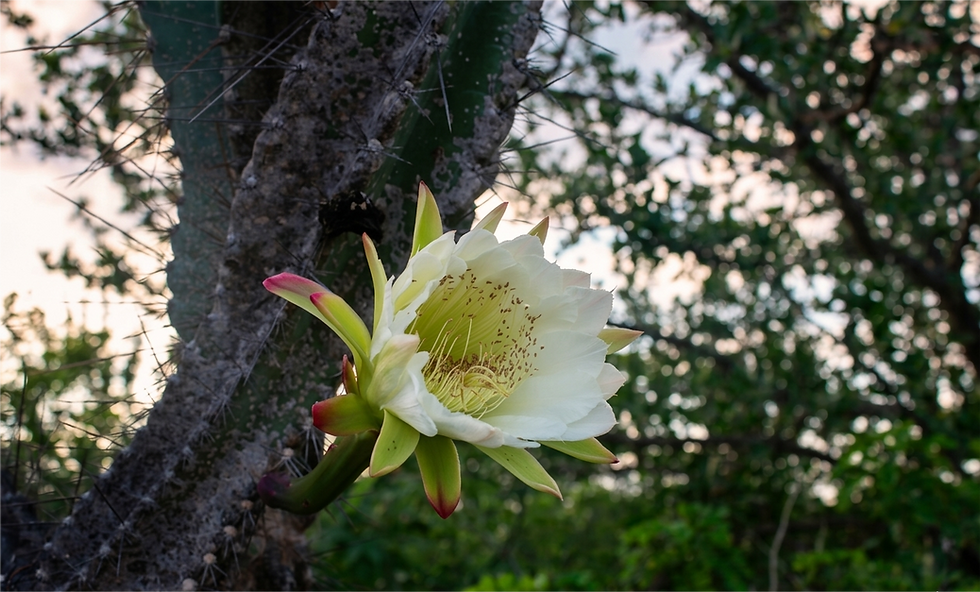
Among them, one stood out in a particular way: the mandacaru flower, fully open.
A different encounter
This was not the first time I had come across a mandacaru flower. I had recorded it before, in another context. But this time, the encounter was different because my way of seeing had changed.
Previously, I had already made a graphite study of this flower.
However, it was based on images available on the internet—useful references, yet limited.
Without the presence of the plant, certain details do not reveal themselves.
What only the field can show
By observing the flower directly, I noticed aspects that had not been visible before:
variations in the internal structure;
details within the stamens;
relationships of depth and form.
These elements completely transformed the way I understand the flower.
The body within the territory
This encounter was not only visual. I was in motion, in the middle of the route—and to stop, to observe, to move closer to the plant: all of this is part of the experience.

The beginning of a journal
It is from this moment that I begin to organize this process more consciously.
Thus, the 🌿 Caatinga Field Journal is born.
A space where observation, drawing, and painting come together. More than recording forms, this process is an exercise in attention.
Learning to see what has always been there. And perhaps sharing this way of seeing, so that others, too, may recognize the beauty that exists along the path.


Comments