Mandacaru Flower: Botanical Observation in the Caatinga Field Journal

Updated: Mar 31
Mandacaru: when drawing meets the flower
Before encountering this flower along the way, I had already drawn the mandacaru flower. The first study emerged from images I found on the internet. They were beautiful photographs, useful as references, and they helped me understand the general form of the flower: the long petals, the luminous center, the contrast with the cactus’s spiny green.
However, at that moment, the drawing was still an approximation — an exercise in observation mediated by screens. It was only later, in the presence of the flower itself (Cereus jamacaru), open before me, that I realized how much there was still to see.
The first study
While drawing from images, I focused mainly on the external structure of the flower: the opening of the petals, the central axis, the contrast of light. Yet some details remained silent.
The encounter with the flower
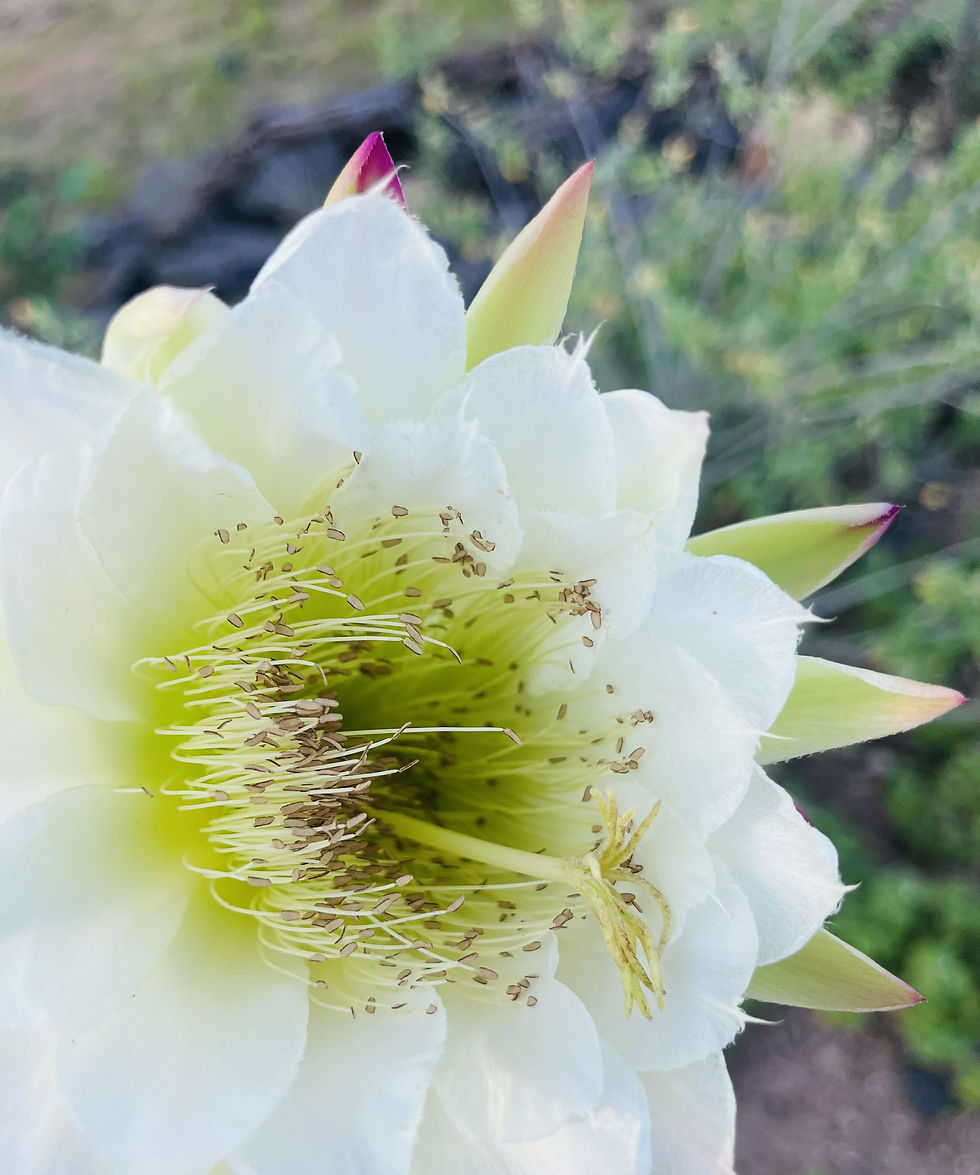
When I finally found the flower open in the field, the experience was different. The flower was no longer just a form. It held depth, rhythm, and subtle variations that images could not fully reveal. As I moved closer, I began to notice things that had previously gone unseen.

What the eye discovers in presence
While observing the flower directly, certain details began to emerge with greater clarity:
variations in the structure of the stamens;
differences in size and direction among them;
the way some gently curve toward the center;
the delicacy of the transition between the stamens and the pistil.
These small differences completely transformed the way I understand the flower.
What once appeared in the drawing as merely a luminous center began to reveal itself as a complex structure, full of movement.
What changes in the drawing
Noticing these details transforms the way of drawing. The gesture is no longer merely a reproduction of form; it becomes an exercise in attention.
Each line begins to carry an attempt to understand the plant: how it opens, how it organizes itself, how it occupies space.
In this moment, drawing becomes a way of studying.
In the field journal
This encounter with the flower marked a subtle shift in my process. Before, the drawing came from images; now, it begins to emerge from the encounter with the plant itself. The field journal becomes a place to record not only the forms of Caatinga flowers, but also what the eye learns through careful observation.
Here is an invitation to draw the mandacaru flower (Cereus jamacaru DC., Cactaceae) once again.


Comments